Translator’s Note
Despite being the largest and most populous country in Southeast Asia and the fourth most populous country in the world, Indonesia occupies a relatively small space in the global poetry scene. Remove the literary canon, such as Sapardi Djoko Damono and Chairil Anwar, whose legacies are secured, and many contemporary Indonesian poets, numbering in the thousands, remain severed from their audience. The literary infrastructure in Indonesia remains small and mostly gatekept, making it difficult for writers to sustain themselves purely through their craft. Accordingly, many writers turn to journalism or industry-related careers.
For those who continue to write stories, plays, or poems alongside their day job, another challenge emerges: the energy that fuels all forms of writing—whether creative, academic, or professional—comes from the same well. If one is already exhausted from work-related writing during the day (the writing that sustains oneself and one’s family), it is rare to find the energy to continue personal creative projects at night.
Even if an Indonesian writer manages to complete a manuscript, when their hours aren’t being wasted in traffic, there is no clear guidance on how to publish. The tutelage of poetry writing, typically found in Creative Writing programs under English departments in American colleges and universities, does not exist in Indonesia. Everyone follows their own path, perhaps sharing their poems online or at open mics in bars and bookstores, where great dialogue around poetry and writing occurs, but minimal feedback is exchanged. I never believed I could make a living as a writer in my country, though I did try.
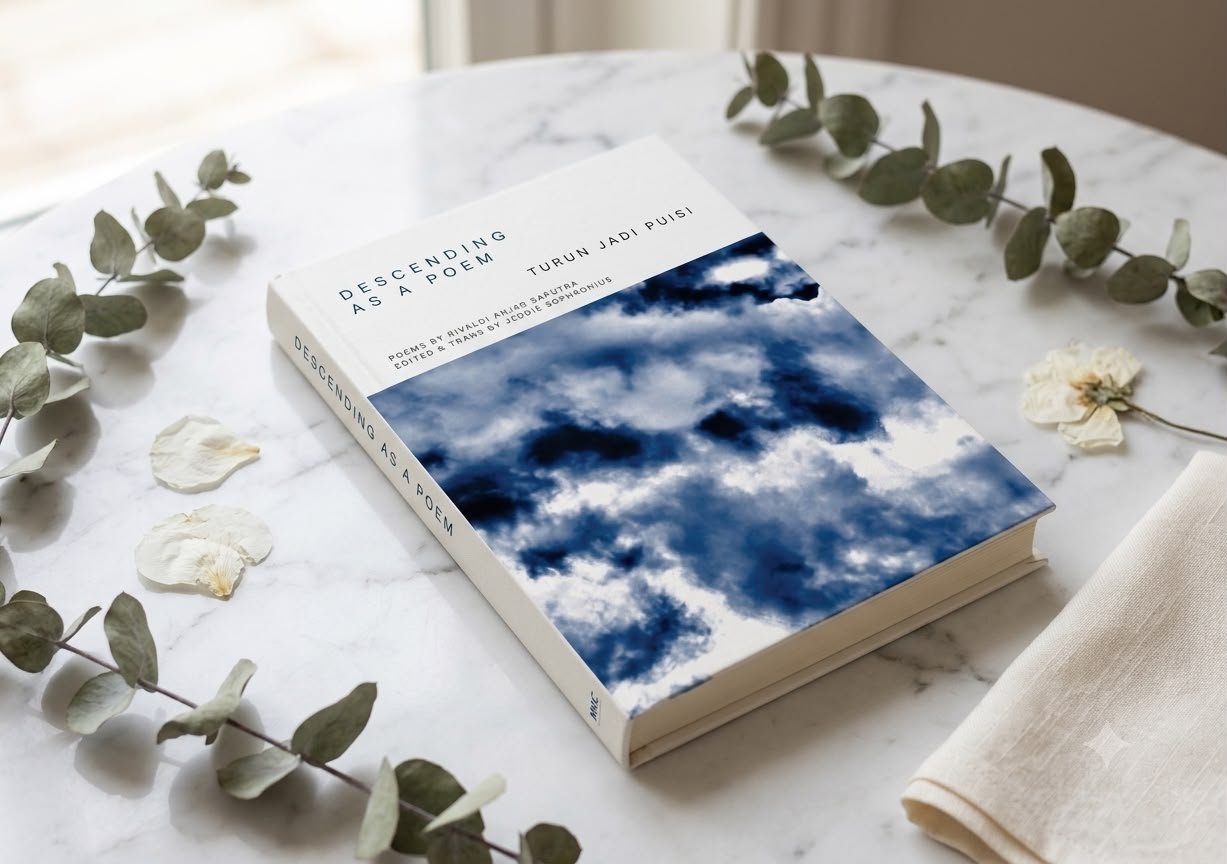
Despite the lack of infrastructure, support networks, and willing mentors, some continue to write. Rivaldi is one of them. Rivaldi and I first met briefly in 2014 when he visited Jakarta from Malang for leadership training. We met at my late grandmother’s house, which was repurposed as the base camp for his program while I was still freelancing; my writing then centered mostly around translation, a bold attempt at making a living solely through words.
Years passed, and I recall my sister recommending a poet from Indonesia. To my surprise, it was someone I had met before. Despite a population of nearly 280 million, I remember every poet I have met in my home country; an amusing contrast to the United States, where I have encountered countless poets and writers at readings and lectures, too many to recall.
Rivaldi and I did not cross paths again until 2024 at my mother’s funeral. In the decade since our last meeting, we have both published our respective poetry collections. Our mutual affinity for verse led us to embark on the journey of translating Rivaldi’s third full-length collection from Indonesian to English. In our meeting, we discussed the idea of “Schools of Poetry” and how he never felt aligned with any. We talked about free verse, lineation, stanza length, capitalization, subject matter, and divinity.
Although my writing career began as a translator, my prior experience did not fully prepare me for this task. The project challenged me to choose between the writer’s intent and the audience’s understanding. At times, I felt like a shepherd trying to herd two different flocks of sheep at once, an impossible task without letting some stray. I had to be mindful of my own biases about form, music, symmetry, and order, especially when the author’s intention diverged from my instincts.
Many contemporary poets—who are probably unfamiliar with the Sufi, Jesuit, or Daoist poets— echo that spirituality and poetry belong in distinct realms, yet I can no longer deny feeling the warm ashes of their union. I hope Rivaldi’s poems show us this new realm of possibility.
—Jeddie Sophronius
Descending as a Poem
Author’s Note
I have always believed that poetry succeeds where other forms of expression fail—it becomes the incarnation of the deepest contemplation. Poetry helps me grasp the abstract, things I might never touch with my senses. This belief is echoed by Joko Pinurbo in one of his books: Poetry is concretization, not abstraction. Poetry expresses abstract soul experiences through concrete images or descriptions, which can touch and stimulate the senses. Poetry, then, has helped me in at least two fundamental aspects of my life.
The first is self-actualization, a primary human need according to Abraham Maslow. Since 2015, I have been writing essays and articles, but poetry was the last form of writing I discovered—or perhaps, poetry found me. Each poem I wrote awakened something within me, drawing me further into its world. Writing poetry became a journey of self-discovery, a kind of psychological therapy that helped me navigate my identity.
The second is spirituality and religiosity—the central themes of this book. I have often found religious rituals and traditions to feel dry, barren, and unable to stir anything within me. Poetry, however, offers something different—like a stream of water refreshing my soul. Since 2016, I have captured these feelings and experiences through poetry. Some poems emerge fully formed in a single sitting, while others undergo multiple revisions. Some are inspired by biblical texts, which I reflect on and adapt freely.
I do not concern myself too much with technical perfection. Perhaps that makes me a bad poet, but to me, honesty is what matters most. Many of my poems did not originally have titles; I only added them later for the sake of publication. Titling them, I’ve found, is often the hardest part.
One important note—a conversation with Jeddie made me realize I should explain why I always include the city and year at the end of each poem. This practice serves as a kind of personal credit, a reminder of where and when a poem was written. These timestamps help me recall specific moments with precision and allow me to track the evolution of my poetic style over time.
Ultimately, this book is not an exploration of a single religious tradition but a broader reflection on how the Divine can manifest in any form, in any circumstance. If, in my religious tradition, God can become incarnate—can take on a body—then why can’t God also take the form of poetry?
—Rivaldi Anjar Saputra
Rivaldi Anjar Saputra, a poet based in Purworejo, Indonesia, is a graduate of psychology and divinity. He is currently a pastor-in-training at GKJ Purworejo and one of the founders of the poetry community @nukilanid in Malang. His work can be found in Antologi Kebonagung Jilid 1 (2019), Serpihan Kata Yang Berserakan (2019), Puisi Pembebasan II (2020), and Sajak Dwiwangga: Antologi Penyair Malang Raya (2020). He can be found on social media platforms by the handle @rivaldianjar.
Limited copies available